
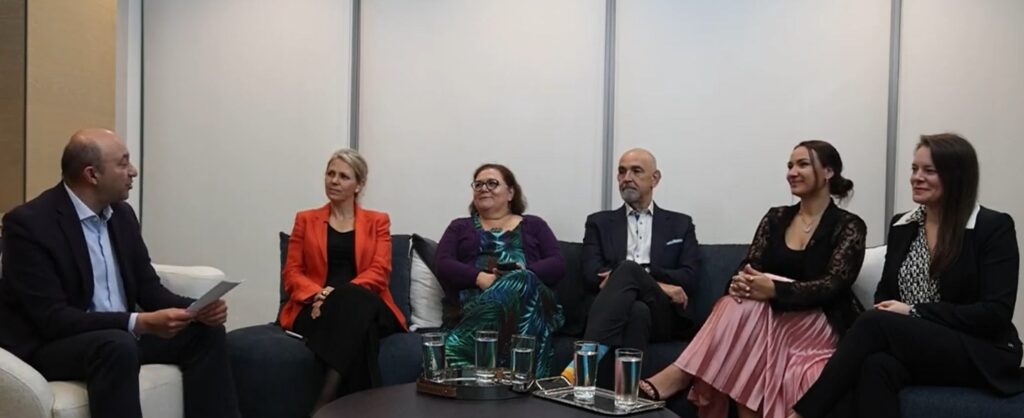
Since 2023, TR2050 has brought together senior reward leaders for panel discussions in Zurich, London, Dubai, Stockholm and Boston, six conversations on how reward needs to change. This series draws them together by theme. Here: the gig workforce, and why it still matters even though it hasn’t grown as expected.
When TR2050’s panel reconvened in Zurich in 2026, it returned to the gig economy, and to an expectation that hasn’t played out. Marc Glaeser, Head of HR for the Specialised Modalities Platform division at Lonza, recalled how much attention the changing composition of the workforce received at the first panel discussion in 2023, “…and I think to be fair, up to now we’ve not had that progress that I think all of us anticipated”. Panellists reported that their organisations have not seen the growth in contingent workers they expected.
It would be easy to file the topic away on that basis. The earlier panels in the series suggest that would be a mistake, because the challenge was never really about volume.
The population that already exists
In London in 2024, Kathrin Kahrass, Group Senior Vice President and Global Head of Reward at the Adecco Group, was asked how well reward systems are coping with the rise of the gig workforce. Her answer was blunt: “I’m not sure it’s coping very well.” Large corporates already have significant contingent populations. “All of us have, I think, substantial populations of gig workers, but I don’t think we’ve really even touched the sides of this in a meaningful way yet.”
Her prescription was strategic workforce planning, which sounds counterintuitive in a world that prizes agility, but which she argued is exactly what’s missing: “making a deliberate choice about the mix that you would like and then actually build deliberately and in a structured way towards that.” She also noted where the advantage lies, and it isn’t with the large employers: “start ups and young companies have a huge advantage over the large established corporates because there’s fewer things to change.”
Dominic Cole-Morgan, Group Reward Director at WPP, took the argument somewhere more uncomfortable. It is procurement, not reward, that manages these contracts, and “the procurement team who manage the contracts for these gig people are being responsible for more money in people’s jeans than we are going to be going forward. So, actually we need to muscle in on this, make sure we don’t become obsolete ourselves.”
He was candid about why the profession hasn’t. “What is preventing us embracing the gig economy? Legislation for one, our legal team are always advising, well, you need to do this, because otherwise they’ll be seen as an employee.” Tax jurisdiction, employment rights and anti-abuse rules all pull in the same direction, and the practical effect is that the more reward tries to offer contingent workers, the closer it moves them to employee status.
Gig workers are not one group
Part of the difficulty is that the term flattens very different people into a single category. In Dubai in 2024, Fermin Diez, total rewards expert and adjunct professor at the National University of Singapore, made the distinction that matters most: some people choose this way of working, and some are pushed into it.
“We don’t want to be corporate and I don’t want to be paid like a corporate,” he said of his own choice. “I want a different way of working.” But he was equally clear that the other case exists: “it’s also true that sometimes people are being almost forced to go into a gig type of work and not of their choice, and I think this is a problem that needs to be addressed.”
On the London panel, Michael Piker, a global HR executive who also lectures on reward, described the same choice from the inside: “I have spent 30 years going around the world as a freelance gig worker, and I love it. I have no intention for working for a company, one single company for 30 years, and get a DB plan. That’s not me.”
Peter Newhouse, a global reward advisor, offered the most useful segmentation of the wider workforce that any of the panels produced, dividing it into four groups. There are people whose skills can simply be bought, “and there’s that horrible word, fungible. They’re replaceable”, typically outsourced, and worth remembering because “they don’t work for you, they work for a big company that supplies that skill to you, but they think they work for you”. There is a large associated population of advocates and influencers who will never be paid by the organisation at all. There are the permanent employees where reward already concentrates its attention. And there are “people with a secret sauce that make your company great. Without those people, your company has no future, you’ve got to look after those people very carefully.”
For the group in between, the skilled contingent workers an organisation buys in, his suggestion was to offer something that outlasts the engagement: “some kind of accreditation experience, something that they can carry forward as an investment in themselves that will reflect well on you as somebody they’ll keep coming back to.”
And the boundary is blurrier than the categories suggest. Nancy Gleason, Professor in Practice at New York University Abu Dhabi, pointed out that plenty of permanent employees are effectively gigging inside the organisation already: “if you Google me, I have three different titles with the same employer.”
Why copying employee pay is the wrong instinct
The obvious response to gig workers is to pay them as much like employees as the law allows. Fermin argued that this is wrong on two counts. “It’s a mistake to assume that the way we pay full time workers is right,” he said, and it’s a further mistake to then extend that model outwards.
His alternative is a distinction worth holding onto: “There must be equity. Equity in the amounts. Equity in what a skill is worth. Equity and contribution commensurate to pay, but not necessarily in the mechanisms on which we deliver this pay.”
Mariia Lytvyn, then Global Head of Total Rewards at GFG Alliance, translated the principle into design. “It’s not necessarily they will be motivated and driven by standardised cash rewards,” she said. “Perhaps the incentives would be providing them the opportunity to access the top quality projects, providing them the opportunity to have flexible scheduling and just basically building rewards around flexibility.” She also flagged the constraint any such design has to respect: organisations must be “mindful not to create this absolute wide gap in between our full time workers and gig workers”, or risk disengaging the permanent workforce in the process.
Dominic suggested the trade could run the other way too. If people want the freedom the gig economy offers, employers could offer more of it rather than lose them: “I think we could probably make our employees more like gig employees if they want to be”, including arrangements where someone can “travel around Southeast Asia and come back as an employee”.
Pascale Saar-Navile, Director of Group Performance and Reward at AIA, added the structural point. As working models diversify, “the workforce becomes much more complex”, and that complexity can’t be handled by reward alone; it needs talent, engagement, learning and design working together. She also raised the piece most often overlooked: “I think we shouldn’t forget about benefits. Benefits have been originally designed for the traditional working model.” And a fairness warning that is easy to miss in a discussion about flexibility: “the pay gap for women in the gig economy is larger, significantly larger compared to traditional, in particular full time working female”.
Organisations already know more than they think
In Boston in 2024, Billy Schultz, Global Vice President of Total Rewards at Mars, questioned how novel any of this really is: “when we say gig worker, how new of a concept is this? There’s plenty of companies who have seasonal workforces, and farmers, big box companies, landscaping companies, amusement parks.” His organising principle was mutuality: “what is the associate, or what is the gig worker looking for? What is the company going to provide, and is it a match?” Alongside it, transparency: “if this is a gig for a moment in time, are we being transparent about that this is a short term engagement for a particular purpose, and it ends at this moment.”
His fellow panellist Stacey Rapacki, Vice President and Head of Compensation at Northwell Health, described what that looks like where it’s already routine. Healthcare “uses per diems quite a bit”, and her organisation’s per diem staff go through the same orientation, including the cultural orientation, as everyone else. They are treated as an extension of the workforce rather than as gig workers, with the hope that some will convert to permanent roles.
Manjit Gill, Senior Vice President of Global Total Rewards at Otis Worldwide, identified the gap most often reported by contingent workers themselves, “feeling the need for connection”, and asked what employers might do about it: “Can you do mentorship programs? Can you offer some sort of skills development?” The point, in his framing, is to stop treating the two populations as “segmented and completely separate”.
Asha Nataraja raised the question that matters most in markets without universal healthcare: whether employers might extend benefits access to contingent workers, given that “you still have buying power and negotiating power to have lower priced healthcare available”.
Back to first principles
Hem Patel, then Vice President of Total Rewards at Moderna, brought the discussion back to fundamentals. Whatever the contract, “you want people doing their best work, whether you’re gig workers or your employees or contractors”. And the profession doesn’t yet know enough about what drives that for contingent workers: “Gig workers are people too, and so they have purpose… we need to kind of almost go back to first principles before we start designing and thinking about, what does rewards look like for that population?”
Peter Newhouse put the same idea in plainer terms, describing what he called the voice of the employee: “people want to be valued, recognised and fairly rewarded.” Nothing about that changes with the contract type.
In Stockholm in 2024, Fermin made the observation that ties the theme together. Reward already personalises for this population without noticing: “we do a lot of customization already with the gig workforce, because we hire different gigs on different contracts for different reasons”. And the direction is one way: “the more our workforce becomes part time or gig, the more we’re going to have to embrace different models.”
The gig surge the panels once anticipated has not materialised, at least not yet. The population that already exists, largely unexamined by reward and managed by procurement, is reason enough to do the work anyway.