
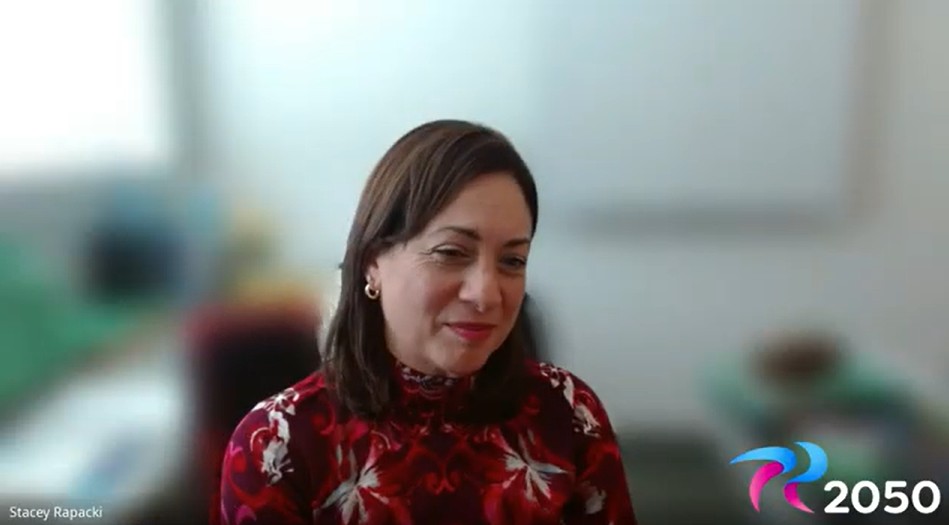
In this conversation, Dominic O’Kelly, TR2050 Founder, Stacey Rapacki, Vice President Head of Compensation, and Jordana Zangwill, AVP, Corporate Social Responsibility at Northwell Health discuss an AI pilot designed to automate job description creation and job levelling – two essential but resource-intensive processes in HR and Total Rewards.
The pilot offers an example of how organisations are starting to experiment with AI not as a replacement for human expertise, but as a tool to augment and scale it. The discussion reflects the kind of work TR2050 exists to support: grounded in real organisational need, tested in the field, and shared openly to accelerate learning across our global community.
This conversation explores:
-
Why job documentation was chosen as a starting point for AI in HR
-
How internal AI capabilities were developed and deployed securely
-
What validation and compliance measures were critical
-
What lessons are emerging from an iterative test-and-learn approach
-
How this work supports broader goals such as pay transparency and internal AI readiness
It builds on discussions within the TR2050 network, including work shared by Moderna at our Boston event, and adds to a growing set of open case studies showing where AI is already being tested across the Total Rewards landscape.
Summary: Northwell Health’s AI Pilot in Practice
Hypothesis
Northwell Health hypothesised that Artificial Intelligence could streamline job documentation and levelling—currently a manual and resource-heavy task—without compromising compliance or accuracy.
Core Ideas Being Tested
-
AI could reduce workload on HR and compensation teams by automating repeatable documentation tasks
-
AI could help maintain consistency and compliance with New York’s pay transparency legislation
-
Internal AI capability (rather than external vendors) would allow for faster, more secure, and scalable solutions
-
Human oversight would remain essential, particularly for regulated or certified roles
How the Test Is Being Conducted
-
Internal Partnership: Collaboration between Northwell’s Compensation team and internal AI hub
-
Catalyst: Sparked by similar work shared by Moderna at the TR2050 Boston meeting
-
Training Data: Focused initially on high-volume, standardised roles
-
Methodology: Iterative “build, test, tweak” cycles to refine the model and process
-
Framing: Positioned as a low-risk starting point—focusing on job profiles, not employee data
-
Timeline: Piloted over several months, expanding as confidence grew
-
Validation: Every AI-generated output reviewed by the Compensation team, with support from internal tech teams
Methodology Overview
-
Design: Co-led by Compensation and the AI hub, with engagement from HR partners
-
Process: Iterative testing with continual refinement based on feedback
-
Data Inputs: Job descriptions, levelling frameworks, and compensation data
-
Validation & Compliance: Human review and secure systems to meet regulatory standards
-
Governance: AI use confined to a secure network; formal intake process in development
-
Enablement: AI literacy campaign across the organisation, led by the CHRO and supported by internal training resources
Potential Outcomes
While results are still being evaluated, this pilot may:
-
Reduce administrative load and enable more strategic HR work
-
Improve consistency and quality of job documentation
-
Accelerate compliance with pay transparency laws
-
Demonstrate AI’s scalability across other HR processes
-
Strengthen internal AI capability and responsible governance
-
Offer a replicable model for TR2050 and the wider HR community