
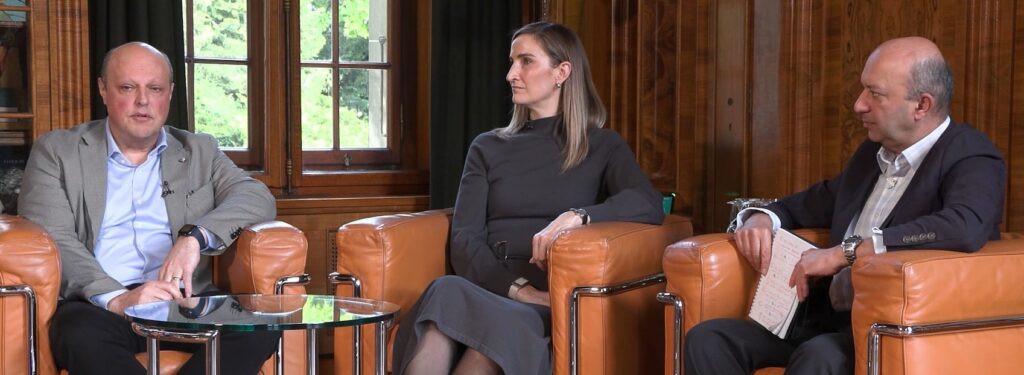
Over the past three years, TR2050 has brought together senior reward leaders from some of the world’s leading organisations for panel discussions in Zurich, London, Dubai, Stockholm and Boston. Across six conversations on three continents, these leaders explored how reward is changing, challenged long held assumptions and shared how their organisations are responding to the changing nature of work. We’re sharing a series of edited highlights from these discussions.
We begin with the topic that has evolved more than any other: personalisation, and why many organisations are moving beyond one size fits all reward.
When TR2050’s panel reconvened at the Swiss Re Centre for Global Dialogue in Zurich in 2026, one shift stood out above the others: personalisation, one of the dominant themes when TR2050 held its first panel discussion in that same room in 2023, has receded, and organisations are moving back towards simplification and standardisation.
What makes that interesting is why it happened. Raluca Ciliacu-Hetzer, Senior Vice President for HR and Global Total Rewards at Barry Callebaut Group, put it down to ease and relevance: how far do you actually take personalisation, and how do you make it sustainable and manageable within an organisation? In her view, employees want explainability, clarity and a degree of choice, but not too much choice, and individualising everything is, in her words, “maybe taking it too far”.
Uwe Kilian, Vice President of Compensation, Benefits, Performance and Labour Relations at Essity, described where that leaves reward design: “For me it’s actually not personalisation anymore, it’s actually more segmentation.” If personalisation is inherently complex, designing for identifiable workforce groups is a way of keeping it simple. Olaf Lang, Global Head of Reward at Swiss Re, saw the same settling from the executive side: whenever he talks to senior executives, “their clear focus is keep it simple, so that people understand our programmes”, and in his reading of the landscape, “what I can see is much more going back to a simplification, partially also standardisation, just to keep it manageable”.
None of this would have surprised the earlier panels in this series. In Stockholm in 2024, Fermin Diez, total rewards expert and adjunct professor at the National University of Singapore, had already walked through what full personalisation quietly breaks: the notion of jobs, and with it job evaluation, job architecture and salary surveys. His reading at the time was that once people thought it through, they realised it is “a pretty idea that will take a lot of work”, which is more or less the judgement the Zurich panel went on to confirm. The London panel, also in 2024, reached the same place through the psychology rather than the architecture, with Ashok Pillai, former Senior Vice President of Reward and Wellbeing at BP, observing that “choice is really appealing but is also debilitating”, and arguing for measured choices built around personas rather than mass customisation.
Which is why the advice Kathrin Kahrass, Group Senior Vice President and Global Head of Reward at the Adecco Group, gave in London in 2024 has aged so well: doing the basics brilliantly, pay equity and pay transparency, is probably more valuable to employees than choice layered on top of foundations that aren’t working yet.
Across six panels and three years, the thinking has converged rather than reversed. Personalisation has been re-scoped into something organisations can actually run: segmentation rather than individualisation, explainability and clarity with some choice but not too much, and the basics done properly first.