
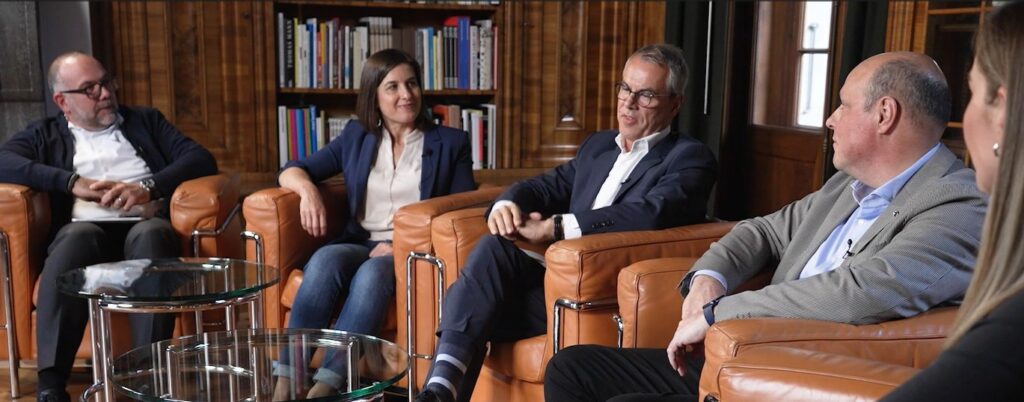
Our series of edited highlights from TR2050’s panel discussions continues. The next theme: technology, and the difference between adopting AI and getting value from it.
When TR2050’s panel reconvened in Zurich in 2026, the panel agreed that technology had moved faster than expected since the first panel met in 2023. What they said next was more interesting: for all that speed, the replacement of roles that many feared has not materialised, and the reason why says a great deal about where the profession’s attention needs to go.
Uwe Kilian, Vice President of Compensation, Benefits, Performance and Labour Relations at Essity, described the two sides of it. The way people now use AI to augment their work and gather data has been remarkable to watch, and yet “it hasn’t replaced anyone yet, so what we all feared was going to happen, that hasn’t accelerated at all”. The reason is that what AI produces still has to be shaped into something of value to the organisation, and in his words that part “hasn’t become any easier”. Raluca Ciliacu-Hetzer, Senior Vice President for HR and Global Total Rewards at Barry Callebaut Group, drew the same line through the data: the tools for making sense of pay data, for transparency, equity and job architecture, have changed materially, but “if you look at total rewards professionals and what they do, I’m not sure that it’s been revolutionised”.
What closing that gap looks like in practice came from Olaf Lang, Global Head of Reward at Swiss Re, whose team introduced an AI augmented chatbot answering employees’ questions about their equity compensation plans. It removed 60 per cent of the question workload from his team, time that could be redeployed elsewhere, with a direct bottom line impact. His wider point was about ambition: the question is no longer whether technology can take on individual process steps, but how to look at it end to end, re-engineering the whole process landscape, in rewards as much as anywhere, to make best use of AI, a journey he believes is only at its very beginning. An earlier panel in this series set out the precondition for any of that, with Max Paping, total rewards expert and adviser to TR2050, telling the Stockholm panel in 2024 that none of the promise materialises unless the basics, clean and consistent data, are in place first.
And it was the Boston panel, also in 2024, that named the question sitting quietly under every AI conversation, when Billy Schultz, Global Vice President of Total Rewards at Mars, said the real question employees are asking is “are you making my job easier, or are you replacing my job?” His fellow panellist Stacey Rapacki, Vice President and Head of Compensation at Northwell Health, put the purpose plainly: the technology is there to keep people doing what they love to do, which in her organisation’s case means keeping teams at the bedside with patients rather than dealing with distractions.
Taken together, the panels describe a sequence rather than a revolution: foundations first, then use cases with a clear return, then honest judgement about where the human belongs. The technology keeps accelerating, and the organisations getting real value from it are the ones doing that work in that order.