
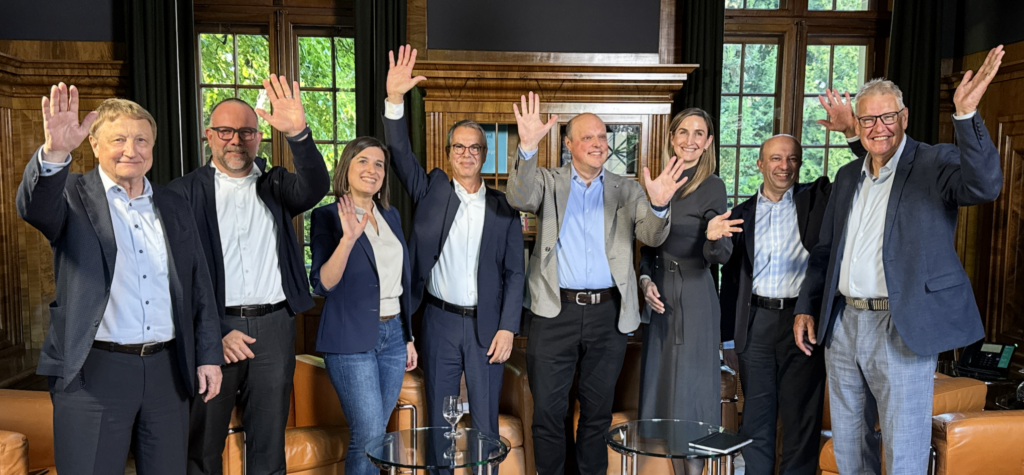
TR2050 Reward Lab – Zurich, May 2026
The TR2050 EMEA Reward Lab in Zurich brought together senior reward leaders, academics and innovators to examine how reward needs to change as work, technology and workforce models evolve.
The focus was practical. The question was not whether reward systems need to change. It was how organisations can test new approaches, measure the results and build evidence that stands up to CEO and CFO scrutiny.
Across the two days, members worked through live research, emerging pilots and practical questions around merit pay, performance management, AI, skills and reward technology.
What drives performance?
One member organisation shared original research examining whether higher merit increases in base salary improve sales performance.
The analysis found a meaningful relationship between base pay increases and sales outcomes. However, the strongest factor was leadership continuity. Stable leadership was associated with a far greater improvement in sales performance than merit increases alone.
The findings also suggested that targeted base pay increases may help offset some of the disruption caused by leadership change. This is not a substitute for stable leadership, but it may be a useful intervention during periods of organisational uncertainty.
A two-year pilot is now being developed in a defined sales population. It will test whether a more segmented merit budget can generate measurable returns through sales performance, retention and leadership stability.
Rethinking performance management
The performance management discussion centred on a clear distinction: ratings are not necessarily the problem. The link between ratings and pay is.
When ratings determine pay, feedback often becomes defensive, managers avoid difficult conversations and employees focus on the outcome of the rating rather than development or contribution.
The group explored models that separate performance assessment from pay decisions. One emerging direction is to use ratings and contribution frameworks to support development, while directing meaningful differentiated reward towards a smaller, clearly defined group of exceptional contributors.
There was also growing interest in team-based performance measures where work is genuinely interdependent. The challenge is to recognise individual contribution without overstating the degree to which outcomes are controlled by one person.
AI, work and human judgement
AI was a central theme throughout the meeting.
Members discussed how AI is changing jobs unevenly. In some roles, it improves speed, insight and productivity without changing the fundamental job. In others, it is redesigning work completely.
AI capability is increasingly becoming a baseline expectation rather than a skill that automatically attracts a pay premium. However, a gap is emerging between occasional users and those who use AI to materially improve their contribution.
The discussion also raised a longer-term concern. As AI absorbs repetitive junior work, organisations may lose the early-career roles through which people develop judgement, commercial understanding and leadership capability. This could weaken future talent pipelines and increase reliance on external, contingent and project-based talent.
The group agreed that AI can improve consistency, transparency and bias detection in reward decisions. However, accountability for reward, performance and people decisions must remain with identifiable leaders.
Technology and compensation benchmarking
A live demonstration explored a new approach to compensation benchmarking, designed to address long-standing problems around data ownership, timeliness, transparency and trust.
Members tested the approach in real time and agreed an initial use case for further development.
A wider scan of more than 300 HR and reward technology vendors also showed that AI capability is becoming more widespread. However, the group reached a clear conclusion: AI capability alone is not the test.
The real question is whether a tool solves a useful problem, improves the work of the user, fits within existing technology architecture and is supported properly after implementation.
TR2050 will continue developing a peer-led technology library based on members’ real experience of tools, use cases and implementation challenges.
Skills-based pay: promising, but not yet solved
Skills-based pay remains one of the most persistent themes across the TR2050 community.
The logic is clear. Jobs are changing faster than traditional pay structures. Organisations risk paying for skills that are no longer needed while failing to recognise skills that have become critical.
However, few organisations have the data, skills architecture or governance needed to price skills dynamically at scale.
The group saw more potential in targeted approaches. These could include temporary supplements for scarce or time-critical skills, rather than attempting to replace job-based pay across the organisation.
There was also a challenge to the assumption that skills-based pay is always the answer. In some cases, the real issue may be workforce planning. The question may be less about how to pay for skills and more about identifying which skills are needed, where they are needed and how long they will remain valuable.
Four findings from Zurich
Four findings stood out across the two days:
- Leadership continuity appears to matter more than merit increases in driving sales performance.
- Decoupling ratings from pay is gaining real traction as a way to improve feedback, development and performance conversations.
- Decentralised compensation benchmarking is technically feasible, with a first use case now agreed.
- Structured, hypothesis-driven testing is becoming a competitive advantage for organisations willing to move beyond opinion and build evidence.
What happens next
The Zurich Reward Lab reinforced the shift from discussion to experimentation.
Members are developing pilots across merit pay, performance management, AI-enabled reward communication, skills-based pay, recognition and compensation technology.
Each pilot will start with a defined assumption, a specific population, measurable business outcomes and a clear point at which the test should stop if it is not producing value.
TR2050 is a practitioner-led community of senior reward leaders running real experiments, sharing real findings and building evidence that stands up to CEO and CFO scrutiny.
The next TR2050 Reward Lab will take place in New York in September 2026.